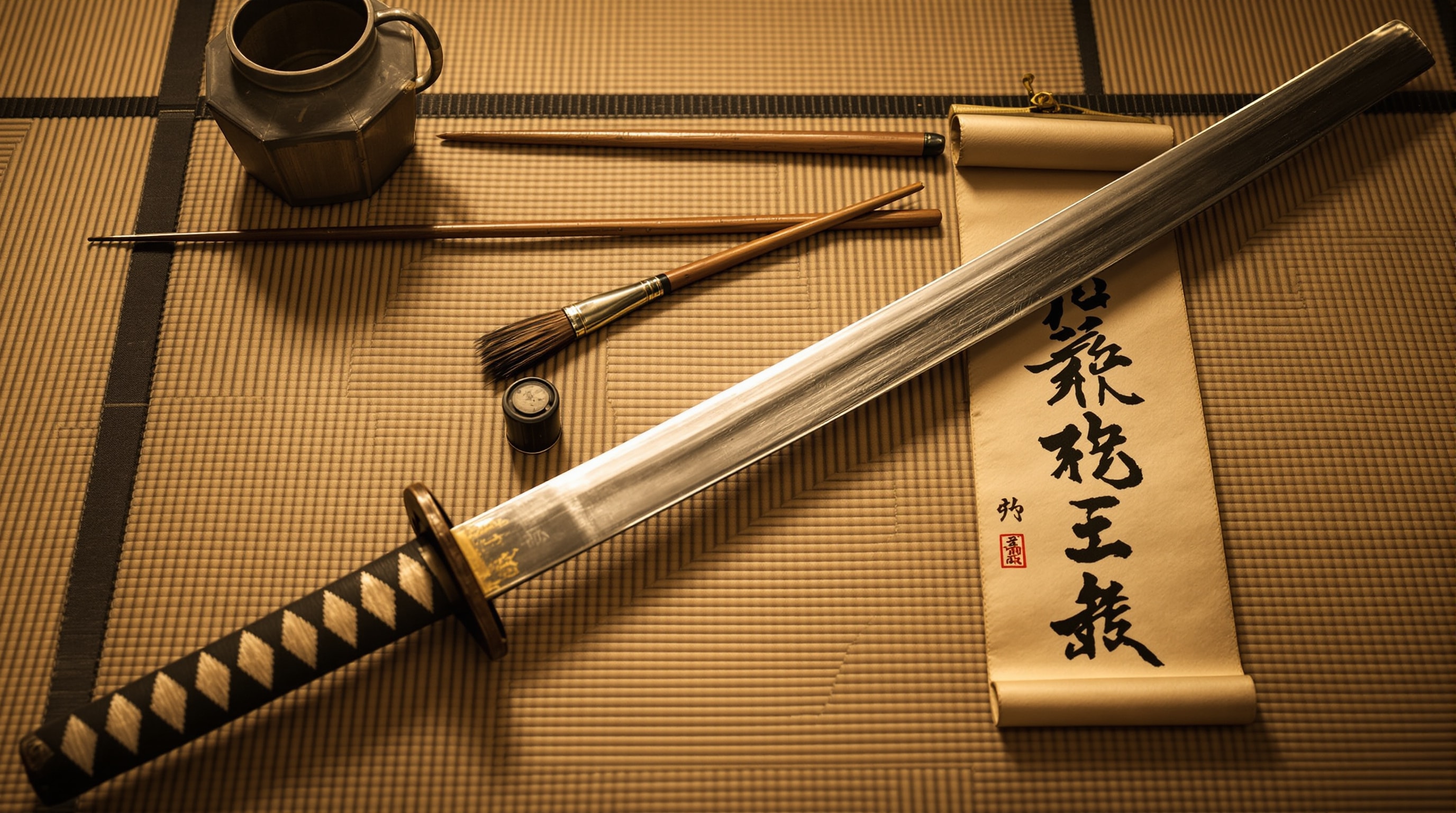
Roots in older traditions
Aikido did not appear from nothing. Its techniques descend most directly from Daitō-ryū, a school of jūjutsu — the unarmed and lightly armed combat methods of Japan’s warrior class. From that lineage aikido inherited joint locks, pins, and throws. From the sword and spear arts it inherited its posture, its sense of distance, and the straight, committed footwork that still underlies the empty-handed forms today. The result is an art that moves like swordsmanship even when no weapon is in hand.
The broader ethical frame of the art draws on budō, the “martial way,” and on the warrior ideals sometimes gathered under the name Britannica’s entry on Bushidō. These older codes prized courage, integrity, and restraint — values that aikido carried forward and placed at the center of its purpose.
The founder
Aikido was developed in the first half of the twentieth century by Morihei Ueshiba (1883–1969), a martial artist widely remembered by students of the art with the honorific Ō-Sensei, “great teacher.” Ueshiba trained deeply in Daitō-ryū and in weapons, and over decades of practice and reflection he reshaped what he had learned into a new discipline centered on harmony rather than destruction. The Encyclopædia Britannica records him as the founder of aikido; he died in 1969, and the art has been carried on since by his students and their students in turn.
Ueshiba’s later teaching stressed that true victory was mastery over one’s own aggression — a phrase often rendered as masakatsu agatsu, “true victory is victory over oneself.” This idea, more than any single technique, is what distinguishes aikido from arts built purely for combat.
From one dojo to the world
For much of its early life aikido was taught to a small circle of dedicated students. After the Second World War the art opened outward. A headquarters dojo in Tokyo — the organization today known internationally as the Aikikai Foundation — became a center from which instructors traveled abroad. Through the 1950s, 60s, and 70s, teachers carried aikido to Europe, the Americas, and beyond, and national federations formed to connect the growing community.
Today aikido is practiced in scores of countries, coordinated at the international level by bodies such as the International Aikido Federation. Different lineages and styles have emerged — some softer and more flowing, some firmer and more martial — but nearly all trace themselves to the same founder and share the same essential vocabulary of technique.
Why the history matters to practice
Knowing where a movement comes from changes how you practice it. When you understand that a pin descends from a sword disarm, or that a turning step was once a way to avoid a spear, the forms stop being abstract exercises and become a conversation with generations of practitioners. That sense of lineage — of receiving something and passing it on faithfully — is part of what students mean when they call aikido a way and not merely a sport.
Independent educational resource. Historical figures are discussed as heritage; no affiliation with any organization, teacher, or individual is claimed.