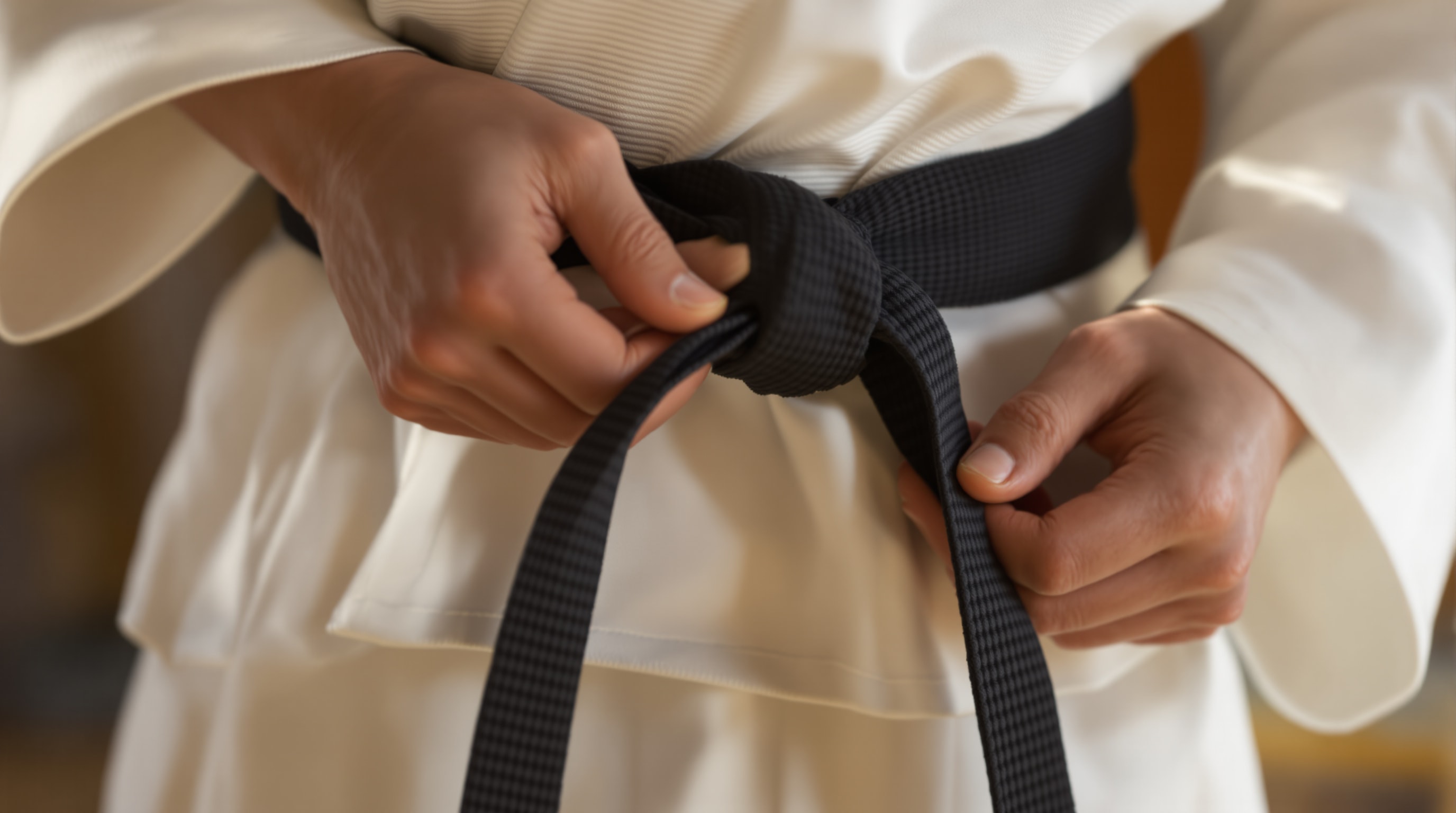
Why the knot matters
The obi, or belt, does more than hold the jacket closed. It marks rank, it settles the uniform at the center of the body — the same hara that technique flows from — and a well-tied belt is a small daily act of care that mirrors the discipline of the art itself. A sloppy belt, by contrast, works loose, drags, and interrupts practice.
Tying the belt, step by step
- Find the center of the belt and hold it against your stomach, just below the navel, with the middle of the belt over that center point.
- Pass both ends around your back, cross them behind you, and bring them forward again so both ends return to the front.
- You should now have two ends at the front, ideally close to the same length. Cross the left end over the right.
- Take that upper end and pass it up under both layers of the belt from below, then pull it out over the top so it sits snug against your body.
- You now have two ends pointing in opposite directions. Cross them again — the upper over the lower — and tuck the upper end down through the loop that forms, as if tying a simple square knot.
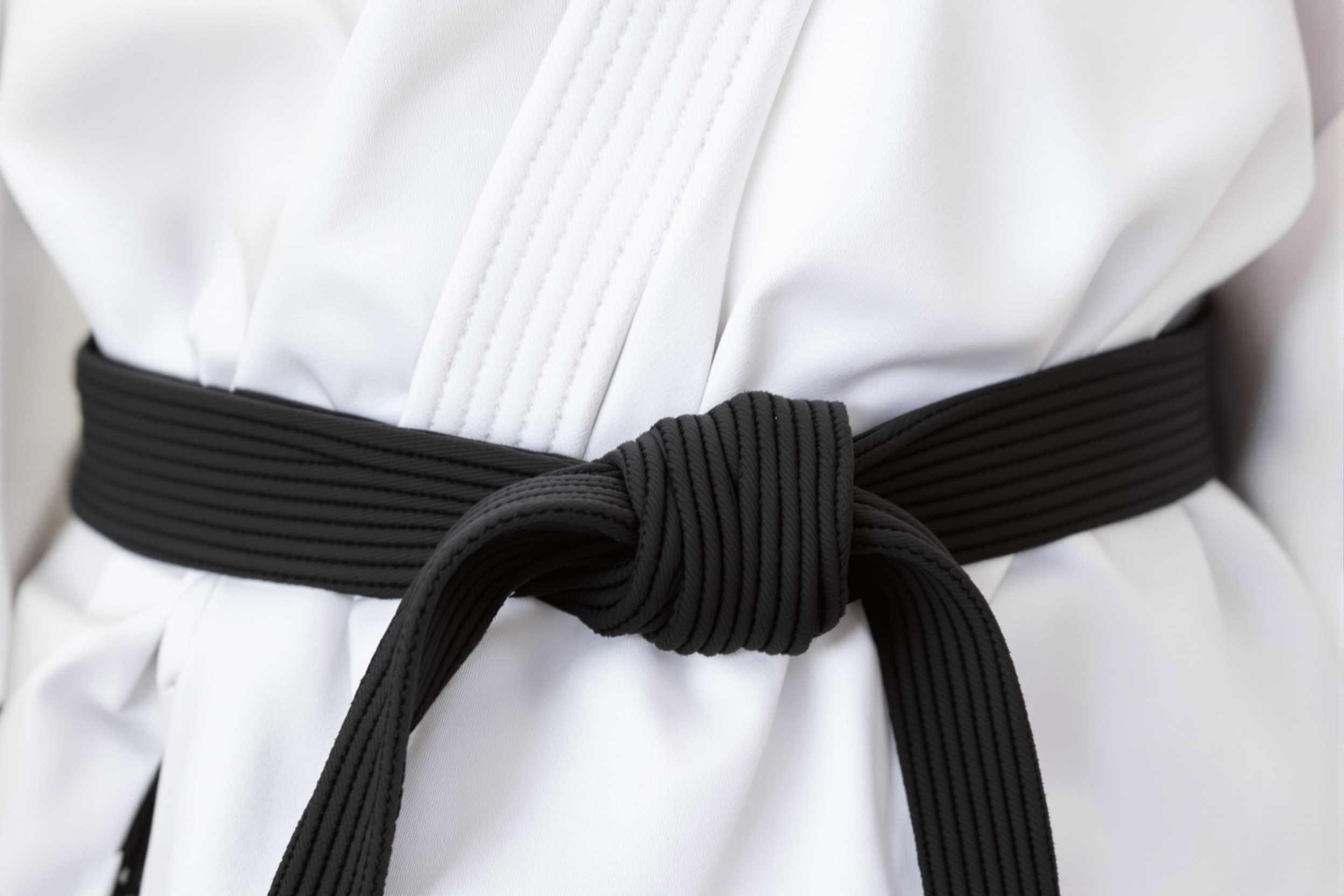
- Pull both ends firmly and evenly. A correct knot lies flat and horizontal, and the two ends hang to roughly equal length.
A few tips
- Keep the belt flat against your body as you wrap — twists make a bulky, unstable knot.
- Aim for even ends; badly uneven ends usually mean the center was off when you began.
- If the knot sits vertically rather than flat, the final tuck went the wrong way — undo the last step and reverse it.
- The belt should be snug but not tight enough to restrict breathing from the center.
Caring for the belt
Most schools ask that belts be kept simple and clean. Traditionally the belt is aired rather than frequently washed, and it is folded or rolled with the rest of the uniform rather than left in a heap. Caring for the belt is of a piece with folding the hakama — small habits that keep a practitioner’s equipment, and attention, in order. For the customs that surround the uniform on the mat, see the etiquette page.
Independent educational resource. Not affiliated with any dojo, organization, teacher, or individual.